Rotation Is Not a Prediction — It’s a Shift in Leadership | 美股茶馆 | 美股茶馆
Rotation Is Not a Prediction — It’s a Shift in Leadership
美股茶馆 · 美股茶馆 · 2025-12-17 09:25 UTC · Views: 1
📊 Rotation Is Not a Prediction — It’s a Shift in Leadership
📊 Rotation Is Not a Prediction — It’s a Shift in Leadership
Most investors think relative strength is about picking winners.
In reality, it’s about recognizing when leadership changes —
often before price action makes it obvious.
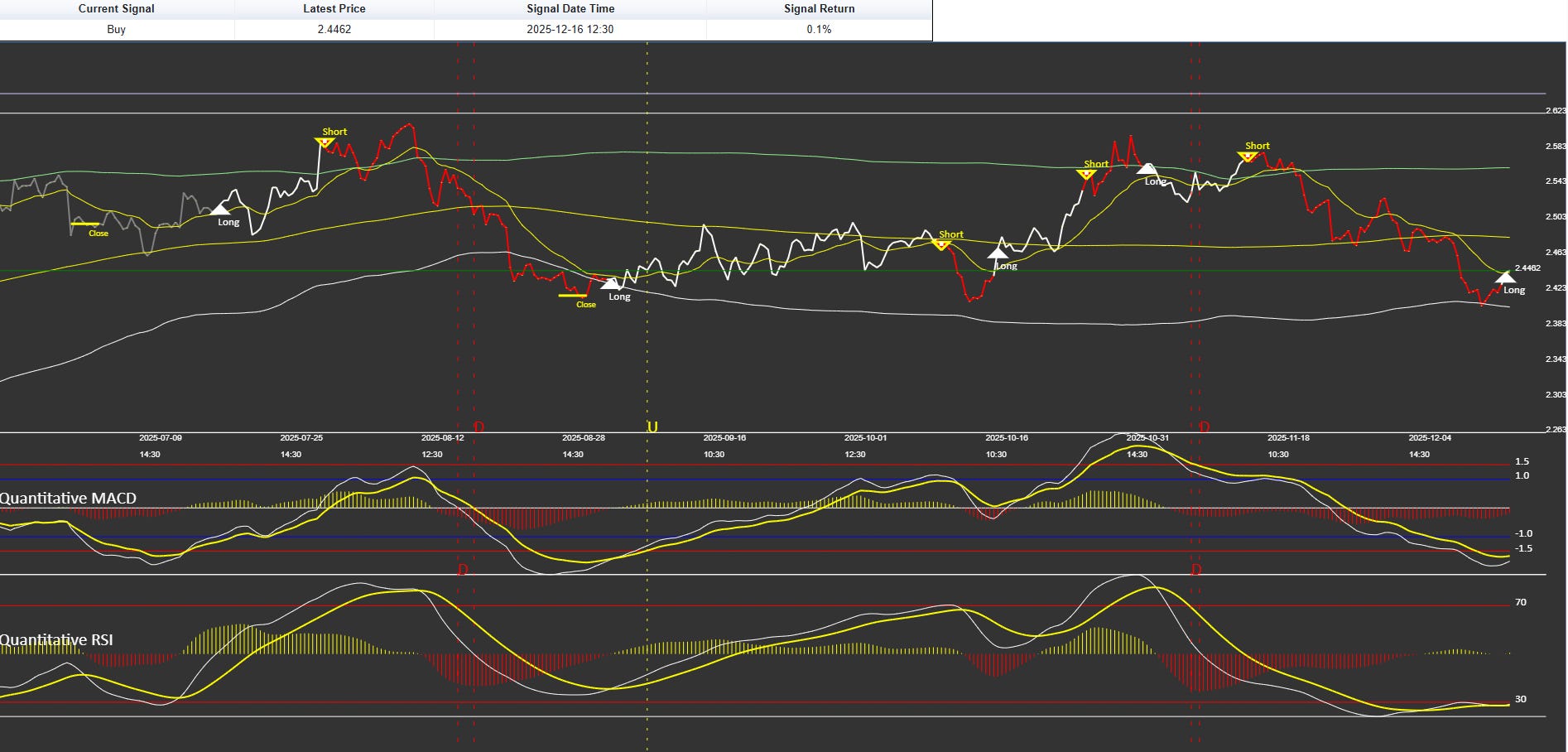
This chart shows a QQQ vs IWM rotation signal.
The latest signal has flipped Long, indicating QQQ is starting to outperform IWM.
What matters more, however, is what happened before that.
1️⃣ The previous signal got the leadership right
At the prior signal, the model indicated:
IWM should outperform QQQ
There was no narrative.
No macro story.
No small-cap thesis.
Just structure.
From November 14 onward, IWM proceeded to outperform QQQ by nearly 6%.
That didn’t require:
Calling a market top or bottom
Predicting rates or the Fed
Timing absolute direction
It only required identifying where capital was rotating.
2️⃣ Why relative strength matters more than direction
Both QQQ and IWM can go up.
Both can go down.
But portfolios don’t live on absolutes —
they live on opportunity cost.
Relative signals answer a different question:
“Where is capital being rewarded more efficiently?”
During the last rotation phase:
QQQ wasn’t collapsing
IWM wasn’t exploding
Leadership simply shifted — and stayed shifted.
That persistence is the edge.
3️⃣ What this signal actually measures (and what it doesn’t)
This is not a price ratio crossover system.
It’s not reacting to headlines or narratives.
The signal emerges from:
Most importantly:
It only changes when leadership actually breaks,
not when it merely pauses.
That’s why the previous signal stayed intact long enough
for the relative move to matter.
4️⃣ The new signal: what it says — and what it doesn’t
The current signal has flipped Long, implying:
QQQ is beginning to regain relative strength vs IWM
This does not mean:
It means something more subtle — and more useful:
The relative tailwind that favored IWM is no longer dominant.
Rotation models don’t predict acceleration.
They detect when persistence changes.
5️⃣ Why most investors miss rotations entirely
Because rotations feel boring.
They don’t come with:
Urgent price moves
Emotional narratives
Clear headlines
By the time leadership is obvious,
the relative move is often already mature.
That’s why rotation is best treated as:
6️⃣ The broader lesson
This is not about QQQ vs IWM.
It’s about how edges actually show up in markets.
Not as predictions.
Not as convictions.
But as:
Relative strength doesn’t shout.
It persists.
Final takeaway
The most important part of this chart isn’t the new signal.
It’s the fact that the previous one worked — cleanly, quietly, and without drama.
That’s how real edges behave.
If leadership is changing again,
it won’t announce itself.
It will simply start to show up —
week after week — in relative performance.
Disclaimer
This content is for educational and research purposes only.
No investment advice. No portfolio instructions.
—
Market Edge Framework