What This Hourly Chart Is Actually Telling Us
Most traders look at an hourly chart and ask one question:
Most traders look at an hourly chart and ask one question:
“Up or down?”
This chart answers a different one:
Most traders look at an hourly chart and ask one question:
“Up or down?”
This chart answers a different one:
“Is this an environment worth pressing risk?”
Let’s walk through what matters — and what doesn’t.
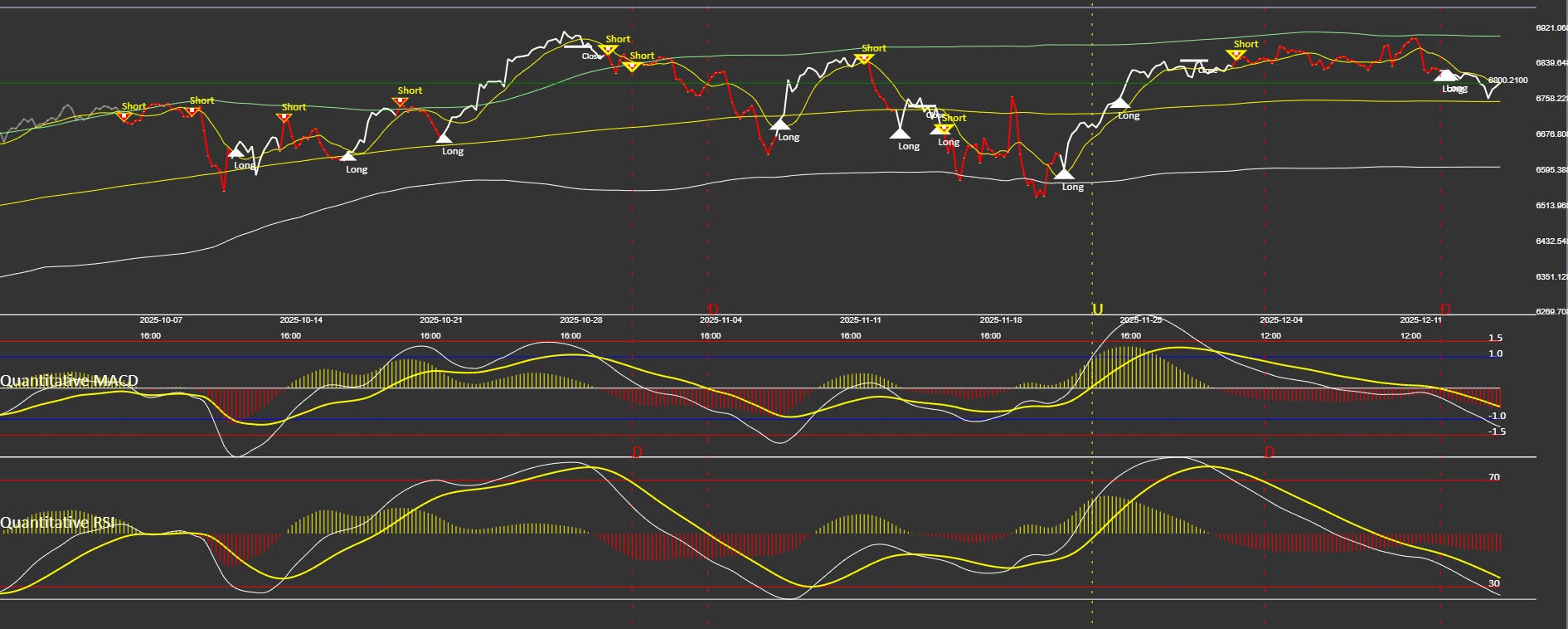
At first glance, price has stayed above the long-term baseline for most of the period.
Many would interpret that as “bullish”.
But notice what actually happened:
Repeated long → short → long transitions
Multiple failed follow-throughs
Momentum oscillators expanding, then compressing
This is not trend continuation.
It’s trend under stress.
When a market keeps testing structure without expanding,
expectancy shifts — even if price hasn’t collapsed.
Yes, there are many valid signals on this chart.
Longs and shorts both appear “correct” in isolation.
That’s exactly the trap.
In this type of environment:
Signals cluster
Outcomes compress
Variance increases
The system may still be right,
but position sizing should not be the same as in clean expansion phases.
This is where most traders lose money:
They trade correct signals with incorrect size.
Look at the momentum structure beneath price:
Peaks are lower
Rebounds are faster but weaker
Oscillators roll over without acceleration
This is not aggressive distribution,
but it is exhaustion.
Exhaustion doesn’t mean “short aggressively”.
It means:
Reduced follow-through
Higher probability of chop
Lower reward per unit of risk
In other words:
the market is paying less for the same effort.
Many traders think restraint is emotional.
In reality, restraint is statistical.
When:
Signals fire frequently
Momentum flattens
Structure stops expanding
The highest-expectancy decision is often:
Trade smaller — or don’t trade at all.
This chart is a perfect example of why
“being right” and “making money” are not the same skill.
This chart is not warning of a crash.
It’s warning of overconfidence.
Markets don’t punish wrong direction first —
they punish overexposure in low-quality environments.
If you treat every signal equally,
this is where drawdowns are born.
If you treat environment as a filter,
this is where capital is preserved.
In the next post, I’ll explain:
Why EMA200 is not an entry signal —
and why treating it as one quietly destroys expectancy.
Paid subscribers will see:
Full signal statistics from charts like this
When identical signals deserved radically different sizing
How environment scoring changes deployment decisions
Disclaimer
This content is for educational and research purposes only.
No trade instructions. No investment advice.
—
Market Edge Framework